


Navigating Fallacies: Sharpening Your Mental Knife for Better Decisions
Strategies for cognitive self-defense in the age of algorithmic stampedes.

Navigating Fallacies: Sharpening Your Mental Knife for Better Decisions
Strategies for cognitive self-defense in the age of algorithmic stampedes.

Wayne Boatwright — Building Tools for the Uncharted
I don’t write to give you answers. I build instruments. These are tools for thinking that help you navigate the places where old maps fail.
These tools are born from years spent dismantling and rebuilding my own mind, learning to separate the maps we inherit from the territory we actually live in. They’re not meant to be admired on a shelf. They’re meant to be used. To be tested against your own life, bent under pressure, and kept only if they hold.
Some are compasses for finding clarity when truth feels slippery. Some are knives for cutting through noise to what endures. All are built for the same purpose: to help you think in ways you didn’t know you could.
If you’ve felt the ground shift under your assumptions, you’re in the right place. The known world ends here. Pick up a tool. Let’s see what survives the journey.
With relentless commentary from your internal skeptic, Murderbot, who’d still rather be watching Sanctuary Moon or Korean dramas.
Your brain processes roughly 11 million bits of information every second, yet only about 10 to 60 bits reach your conscious awareness. This remarkable filtering system that helped our ancestors survive on the savanna now operates in boardrooms, voting booths, and coffee shops; making thousands of decisions daily through invisible mental shortcuts that can systematically mislead us.
Recent research reveals that 58% of reasoning errors involve manipulation through distraction, while 56% stem from emotional manipulation. These aren't occasional glitches. They're fundamental features of human cognition that require deliberate countermeasures.
Think of this essay as your guide to becoming a mental craftsman, wielding what we call the Knife of critical thinking. This isn't just another self-help metaphor. Neuroscience confirms that metacognitive training (thinking about thinking) significantly enhances both critical thinking abilities and decision-making outcomes. By the end, you'll possess evidence-based strategies to slice through mental fog and make decisions that serve your actual goals rather than your unconscious biases.
Why You Need a Mental Knife — Whether You Realize It or Not
Richard Feynman had it right when he said, "The first principle is that you must not fool yourself, and you are the easiest person to fool." After decades in business, you've seen this truth play out countless times; in boardrooms, market predictions, and strategic decisions that seemed bulletproof until they weren't.
Your brain, remarkable as it is, wasn't designed for today's complex business environment. It evolved to handle immediate threats, form quick alliances, and remember compelling stories. Now you're asking it to navigate AI disruption, market volatility, and information overload. Using mental software built for a much simpler world.
The Maze of Modern Decision-Making
Think of your mind as navigating a complex maze. Some corridors are well-lit by logic and experience, while others are dimly lit by gut instinct and emotion. Your mental flashlight illuminates only a small area at a time, leaving vast shadows where assumptions masquerade as facts.
You've probably experienced this in your career: a "sure thing" investment that tanked, a competitor you dismissed who later dominated the market, or a trend you were certain would fail but became the new standard. Plato's cave allegory seems quaint compared to the sophisticated illusions we face today.

The Knife: Your Mental Precision Tool
This is where the Knife becomes essential. It's not a blunt instrument to crush emotions or dismiss intuition. Both have served you well in business. Instead, think of it as a precision scalpel that helps you separate valuable insights from misleading noise.
The Knife operates on what Plato called "the art of measurement;" breaking down complex, tangled problems into manageable components without losing sight of the bigger picture. In your business experience, you've likely done this instinctively when:
Analyzing a potential acquisition by examining each division separately
Breaking down quarterly performance by region, product line, and customer segment
Evaluating a new technology by considering its impact on operations, costs, and competitive advantage
How the Knife Sharpens Your Thinking
Modern neuroscience reveals that effective decision-making involves multiple brain systems working together: the prefrontal cortex (analytical thinking), the limbic system (emotional processing), and dopamine-driven circuits (motivation and reward). Each time you use the Knife (catching yourself in a logical fallacy, questioning a bias, or testing an assumption) you're strengthening these neural networks.
Robert Pirsig warned against pure analytical dissection that kills insight. The Knife isn't about becoming coldly logical; it's about maintaining the right balance between analysis and intuition. A sharp Knife:
Measures situations accurately, cutting through hype and fear
Recalibrates your thinking when new information emerges
Hones itself through experience, becoming more precise over time
Murderbot mutters: Self-deception index remains high. Could be worse; could be parsing human poetry.
Here's another hidden blade: your brain processes frequencies far better than slippery percentages. "10% risk" is fog. "10 out of 100 people like you" engages cleaner neural machinery. Studies show natural counts stop you from overreacting or freezing up. Another Knife technique is translating stats into what your cortex actually evolved to handle.
The Cost of a Dull Blade
Every failed prediction, every blindsided decision, every "how did I miss that?" moment is actually sharpening your Knife; if you let it. The executives who thrive in their 50s, 60s, and 70s are those who've learned to welcome these moments as training opportunities rather than embarrassments.
Let your Knife grow dull, and you'll find yourself trying to cut through complex realities with the mental equivalent of a butter knife. You might feel confident (even successful in the short term) but you're setting yourself up for the kind of strategic blindness that has felled many experienced leaders.
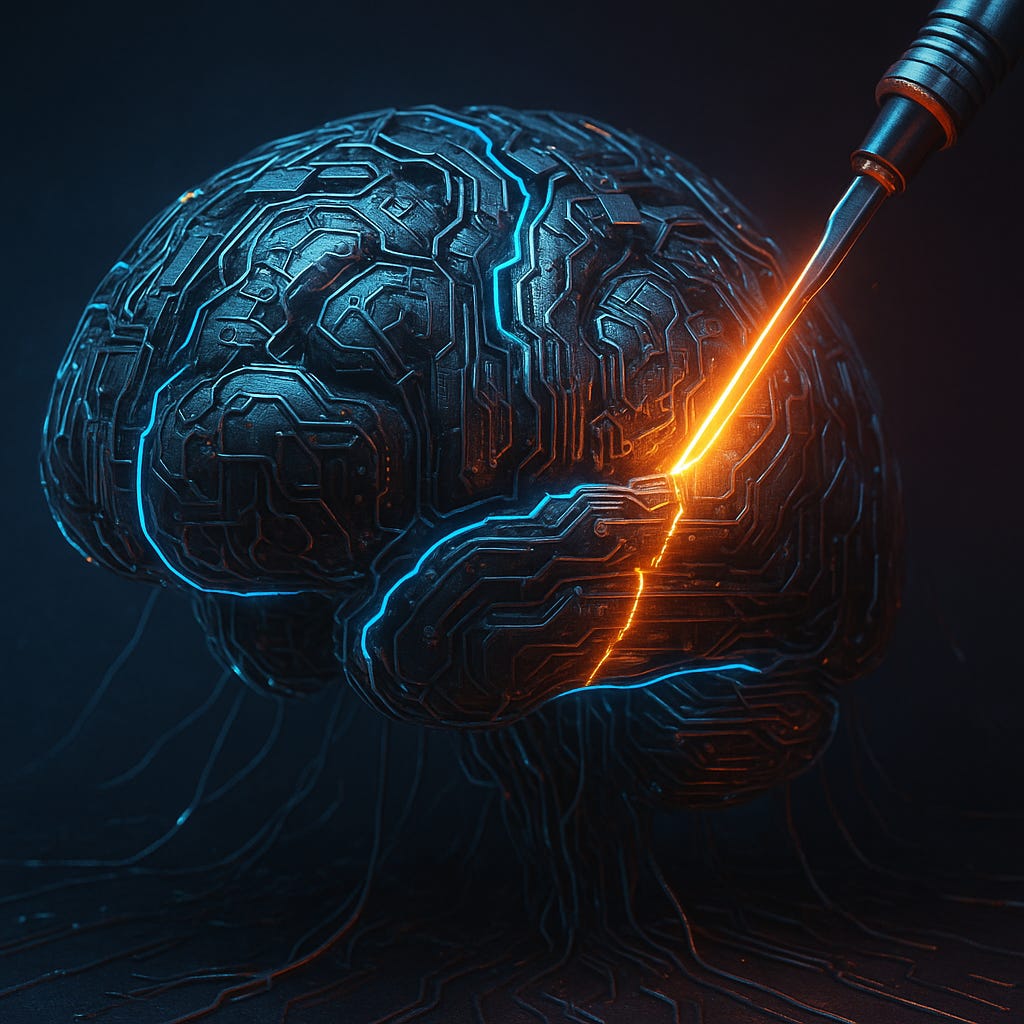
The choice isn't whether you'll face deception and complexity in today's business environment. The choice is whether you'll face them with a sharp, well-maintained tool or struggle with a dull one, wondering why the cuts aren't clean anymore.
Your decades of experience have already been sharpening this Knife. Now it's time to use it deliberately.
Murderbot mutters. Security Log: Self-deception index remains high. Could be worse. Could be parsing human poetry.
Also, your brain processes frequencies far better than slippery percentages. “10% risk” is fog. “10 out of 100 people like you” engages cleaner neural machinery. Studies show natural counts stop you from overreacting or freezing up. Another hidden Knife is translating stats into what your cortex actually evolved to handle.

When the Elephant bolts and the Rider makes excuses
Jonathan Haidt captured it precisely: your mind is an Elephant (emotion, tribal reflex) led by a Rider (reason) who mostly just writes narratives after the Elephant picks a trail.
June 2025 proved it again. LA protests over immigration raids lit up social feeds after one drone clip showed cars on fire. Your Elephant stampeded: “collapse incoming!” By afternoon, your Rider was typing moral essays, stacking selective data. Days later, quieter stats whispered into echo chambers that had already sealed off.
Murderbot sighs through static. Security Log: Emotional velocity at 91%, rational parsing at 7%. Recommend delayed transmission.
Emotion isn’t the enemy — unexamined emotion is
You’re not a Spock, nor should you be. Emotion gives meaning, values, drive. It moves your Elephant and makes life vivid. Left unexamined, it bulldozes clarity. Haidt’s Elephant and Rider shows it: your Rider believes it’s in control but watch what happens under stress. The aim isn’t to amputate emotion; it’s to train the Rider to spot when the Elephant bolts and recalibrate.
Murderbot mutters, unimpressed. Security Log: Humans keep pretending they’re logic processors. Recommend upgrades before next emotional stampede.
This frames everything ahead: spotting fallacies, questioning tribal stories, wielding your Knife.
The tripwire trio: fallacies, biases, heuristics
These overlap like a messy Venn diagram. Fallacies are logic’s circus tricks. Biases are grooves your wiring digs. Heuristics are shortcuts once meant to dodge cliffs, now applied to GDP graphs. Together, they dull your Knife.
Fallacies thrive in crowds. Straw men simplify opponents into paper dolls, easy to burn. Appeals to emotion sprint past scrutiny, straight to your Elephant. Ad hominems torch the speaker so you never touch the data.
Biases carve deeper ruts. Anchoring means the first stat you hear (COVID mortality, stock forecasts) becomes your orbit, even for trained minds. Confirmation bias dresses your wish in respectable logic.
Heuristics once saved your tribe from snakes. In today’s chaos? They chase algorithm-fed ghosts.
Each time you spot one, your Knife slices cleaner. Studies show explicit fallacy inoculation (pattern recognition, why each trick misleads, practicing real debates) cuts flawed reasoning by 17.5%. Kids trained this way stay sharper weeks later. It’s deliberate armor before the next crowd chant.
And always, translate slick percentages to frequencies. “30% increased risk” is haze. “30 out of 100 people like you” clarifies instantly.
Murderbot logs with dry patience. Security Log: Slight improvement. Narrative churn still active. Recommend more frequency framing and Knife drills.
SCOTUS 2025: a live Knife lab
This term felt like Jacksonian maximalism: Medicaid offloaded to states, religious carve-outs strengthened, gender healthcare splintered into jurisdictional puzzles. Feeds screamed: “Freedom’s last stand!” or “Hello theocracy!” But the actual rulings? Narrow, tangled with carve-outs that promise years of local court trench fights.
Your Elephant picked sides in seconds. Your Rider spent days stacking partial quotes.
Murderbot grumbles. Security Log: Comprehension at 12%, tribal lock at 66%. Would prefer Sanctuary Moon.
Echoes older than you: Rome to Jacksonian illusions
Romans bankrupted provinces for bread and circuses, skipping skepticism. McCarthy’s loyalty oaths hollowed professions under patriotic branding. The Elephant thrills at moral bonfires; the Rider writes florid defenses.
Same with Jacksonian “fairness.” Early Americans cheered equality; if you were a white man. The Elephant loved it. The Rider drafted manifestos. It took abolitionists, suffragists, strikes (decades of sharper Knives) to widen the cultural story.
Murderbot blinks lenses. Security Log: Pattern recognized. Emotional drift stable. Continue Knife checks.
Structured cuts: actual strategy
Military teams game out battles from the enemy’s view. Investors run black swan models to stress-test greed. These bore the Elephant. They slow everything. That’s why they work. Structured decisions pull goals into daylight, multiply options, forecast regret. They scaffold your Knife so it doesn’t slip. Over time, tribal murals fade, replaced by maps rougher but truer.
Murderbot hums. Security Log: Cortical fatigue minimal. Adaptive rewiring in process.
Little slices change everything
You’ll still cheer your narrative’s wins, flinch at its losses. Biology demands it. The Knife inserts a beat: Who profits if I keep believing this? What chain of facts could flip me? Enough cuts, and myth drains away, leaving terrain.
Murderbot records coolly. Security Log: Meta-map stabilizing. Next outrage queued for audit.
Conclusion: The Long Game of Clear Thinking
If this sounds like more work than your Elephant signed up for, that’s because it is. Clarity has a cost. Running your Knife along old cherished stories scrapes off comfort in thick shavings. You start to see the people selling you fear. The algorithms dosing you with validation. Even your own heartbeat stuttering when a narrative lands just right.
But here’s the payoff. Michael Lewis would say it’s the only game worth playing: fewer surprises that gut your future self. A life mapped with contours you chose to notice, rather than ruts cut by someone else’s profit. You end up a little more curious, a shade more careful, and (if Murderbot’s logs hold) a lot harder to herd.
Murderbot flickers, half-approving. Security Log: Cognitive sovereignty trending upward. Recommend resuming this exercise after next sentimental meltdown.

Appendix: Knife Drills
(compiled with grumbling compliance by Murderbot, who would vastly prefer to resume Sanctuary Moon or Korean dramas)
Drill One: Medicaid meltdown headlines
Your feed blares: “Millions lose coverage overnight!” Knife test: How many states actually pulled the trigger? Over what timeframe (1 or 10 years)? What transitional funding exists? Who profits from panic, ad sellers, fundraisers? Could the fear still be valid while the scale’s exaggerated?
Drill Two: Project 2025 administrative resets
Friend posts: “Dictatorship incoming through civil service purges!” Knife: What does the draft policy actually propose? What statutory limits still constrain it? Could it signal real danger even if it’s not literal fascism yet? Or, flip the blade, could a bloated bureaucracy be stifling enough innovation and accountability that trimming it is overdue? Your Knife shouldn’t kill urgency, just trim fiction from either side.
Drill Three: The protest fire loop in LA
Same drone clip, endlessly recycled. Caption: “Your city next.” Knife: Five blocks in a sprawl of 13 million? Was it even this month? Who’s monetizing your dopamine spike? Murderbot’s voice is painfully flat. Security Log: Emotional surge at 84%. Recommend cooldown cycle before share.
Drill Four: Hot new crypto pipeline
Pitch lands in your DMs: “34% guaranteed returns, big influencers already in!” Knife: Who regulates this? What math sustains it? Could your craving to belong or to beat the curve be overriding every safeguard? Cut quickly before your wallet bleeds.
Drill Five: COVID variant echo chambers
Your circle is certain it’s either a sniffle or an apocalypse. Knife: What’s ICU occupancy data vs last year? Who frames it mild, who frames it dire, and why? Could this be a situation where both your tribes are selectively wrong?
Drill Six: The family dinner political brawl
Uncle drops: “The country was better off when we all believed the same things.” Knife: When exactly? For whom? What evidence does that nostalgia rest on, and what counterexamples shred it? Murderbot sighs, queues the next episode. Security Log: Familial peace at risk. Knife integrity holding at moderate. Recommend preemptive sarcasm to defuse escalation.
Murderbot finally files off
You’ll never scrape bias completely from your code. That’s fine. The point isn’t to become a sterile algorithm. It’s to slice through illusions fast enough that your future self isn’t stuck in regret over emotional stories you should’ve dissected. Murderbot, already half-tuned to its drama feed, logs out. Security Log: Audit cycle complete. Recheck after next emotional news dump or viral clip. Sanctuary Moon or Korean dramas now resuming.
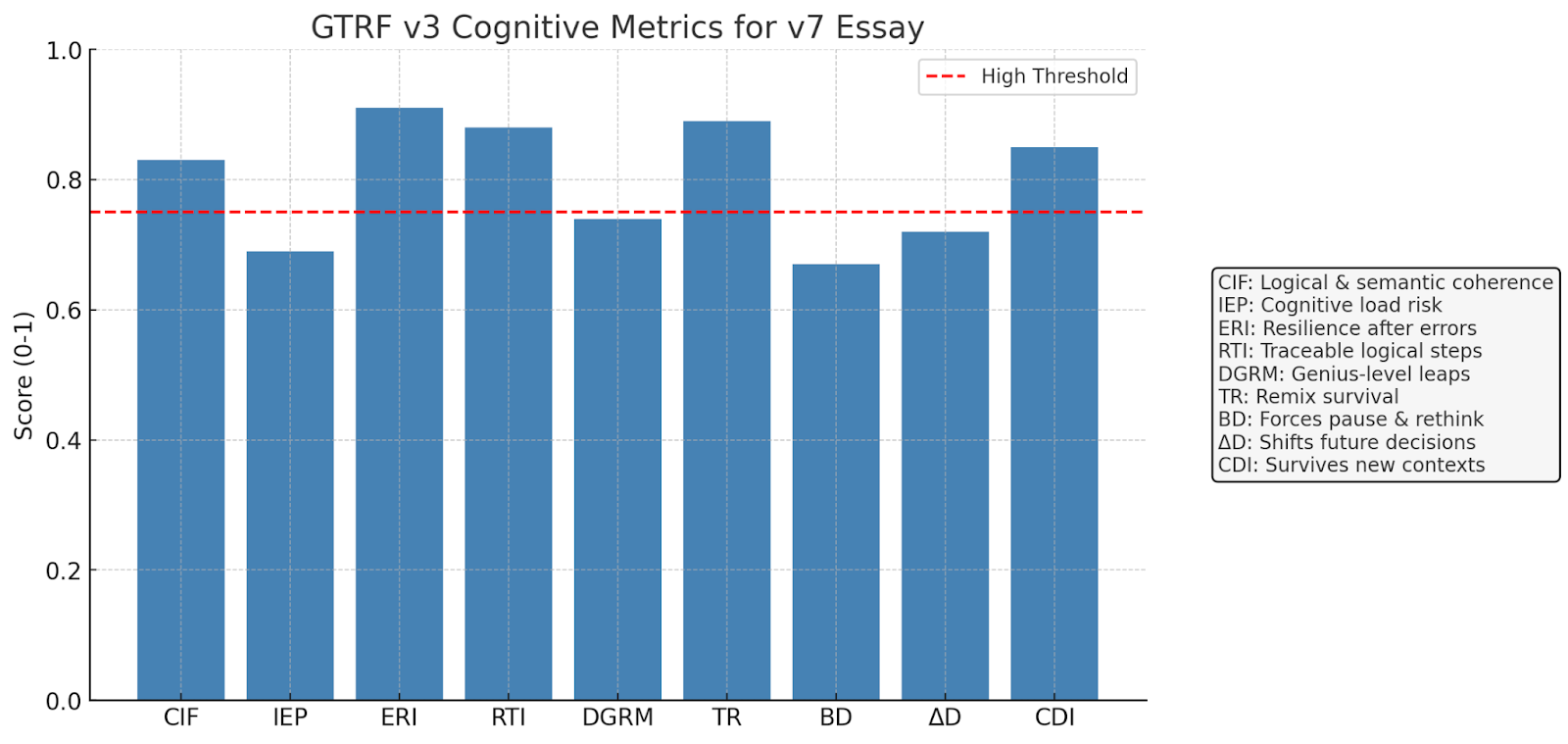
🧭 GTRF v3 Metric Definitions
Metric
Meaning
CIF (Cognitive Integrity Functional)
Measures overall logical, semantic, and structural coherence. Checks if reasoning is internally consistent and conceptually tight.
IEP (Inference Epistemic Pressure)
Assesses the cognitive load; whether the text’s density of ideas risks overwhelming comprehension, leading to potential inference collapse.
ERI (Error Recovery Index)
Tests how well the argument recovers from contradictions or conceptual shocks, showing resilience to flaws or self-correction.
RTI (Recursive Trust Index)
Evaluates traceability of reasoning across steps. High RTI means logical steps consistently follow from one another, reinforcing trust.
DGRM (Decomposable Genius Recognition Metric)
Detects discontinuous or extraordinary leaps of insight like ideas that exceed incremental improvement and restructure how we think.
TR (Transmission Robustness)
Checks how well the idea holds up under paraphrase, compression, satire, or cultural remix. High TR means the core insight is stable across distortions.
BD (Behavioral Drag)
Measures whether the content interrupts automatic thinking, causing the reader to pause or re-evaluate. Like cognitive friction.
ΔD (Decision Delta)
Quantifies how much the idea shifts downstream decisions or attitudes. Its practical influence on future choices.
CDI (Contextual Distortion Index)
Rates how well the idea retains function and meaning after being reinterpreted or placed in different contexts. Low CDI means it distorts easily; high CDI means it holds shape.