
Unlearning the Machine: How Doubt, Data, and AI Rewrite What We Think We Know
Why Peirce’s “irritation of doubt” matters in a world of confident algorithms

Unlearning is fast becoming the defining mental skill of the AI age: the capacity to notice when your old story of how the world works has quietly expired, and to let it go before it breaks you.
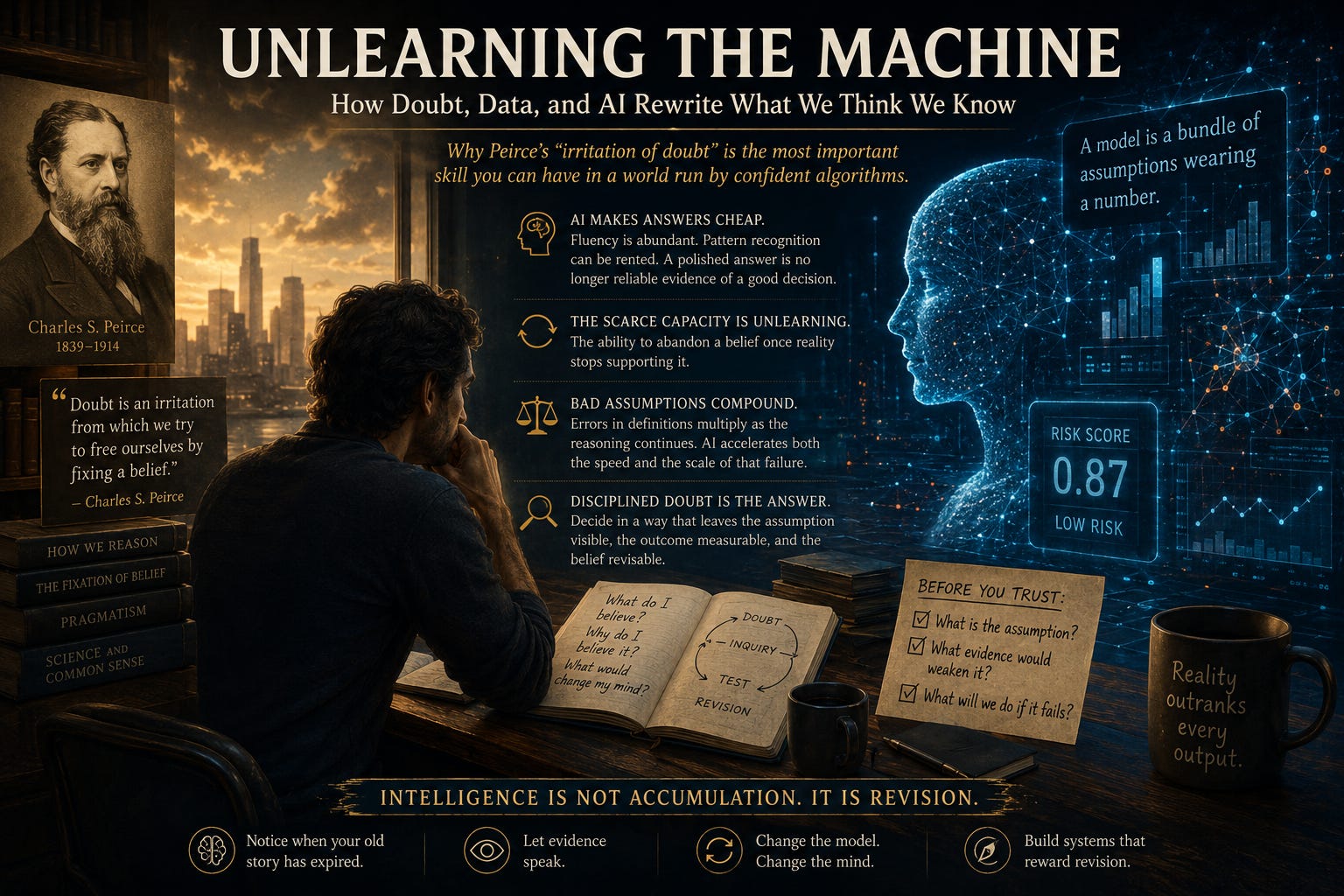
The day the model lied
Consider a composite case familiar to anyone who has worked around predictive models.
The trader was right, technically.
The model was wrong, absolutely.
He had spent six months training a new credit model on ten years of transaction data. It spat out a clean green light on a mid‑sized retailer whose financials, at first glance, looked sound. He loved the model; it made him feel like the smartest guy in the room, the way syllogisms once made medieval schoolmen feel fully equipped for any argument.
Then the retailer missed a payment. Then another. Within three months it was swirling toward bankruptcy, dragged under by an online competitor whose data had barely registered in the training set.
The AI had been exquisitely calibrated on a world that had already begun to disappear.
When his boss asked what went wrong, he did what most of us do when our tools fail: he blamed the data, then the features, then the hyperparameters. It took longer to ask the more dangerous question.
What if the failure wasn’t in what I fed the model, but in how I believed the model?
Charles Peirce, writing in 1877 about how we fix our beliefs, called this moment “the irritation of doubt.” It is the uncomfortable awareness that something in our mental furniture no longer fits the facts. We are not built to enjoy that feeling; our instinct is to slam the door on doubt as quickly as possible. But for Peirce, doubt is the engine of inquiry, because it is the one thing that can force us to change the rules by which we reason.
That is where unlearning begins.
Why AI makes unlearning non‑optional
For most of human history, the half‑life of useful knowledge was generous. A skill you learned at twenty would still be worth something at fifty. Today, the useful life of certain knowledge is measured in product cycles and API updates. AI accelerates this in at least three ways documented across decision-making research and visible in ordinary organisational life:
We are bombarded with more information than we can integrate, so we lean harder on our favorite shortcuts and stories.
Our pattern recognition engine, which once helped us survive in sparse environments, now happily hallucinates structure in noisy data, reinforcing our prior beliefs.
Under time pressure, we default to habits that conserve mental energy, even when the cost of being wrong is rising.
AI doesn’t just add more information to this system. It adds confident information. A large language model states a plausible answer in the same tone whether it is rock‑solid or wildly off. A prediction system outputs a score with three decimal places whether the world is stable or in free fall.
Peirce would have recognized the danger. He argued that humans reach for any method that relieves the discomfort of doubt: tenacity (stubbornly holding on), authority (trusting some exalted source), a priori reasoning (believing what feels agreeable), and, finally, the method of science, which ties belief to what can be checked against experience.
