
What Drift Actually Is
(Before It Becomes a Plot Twist)

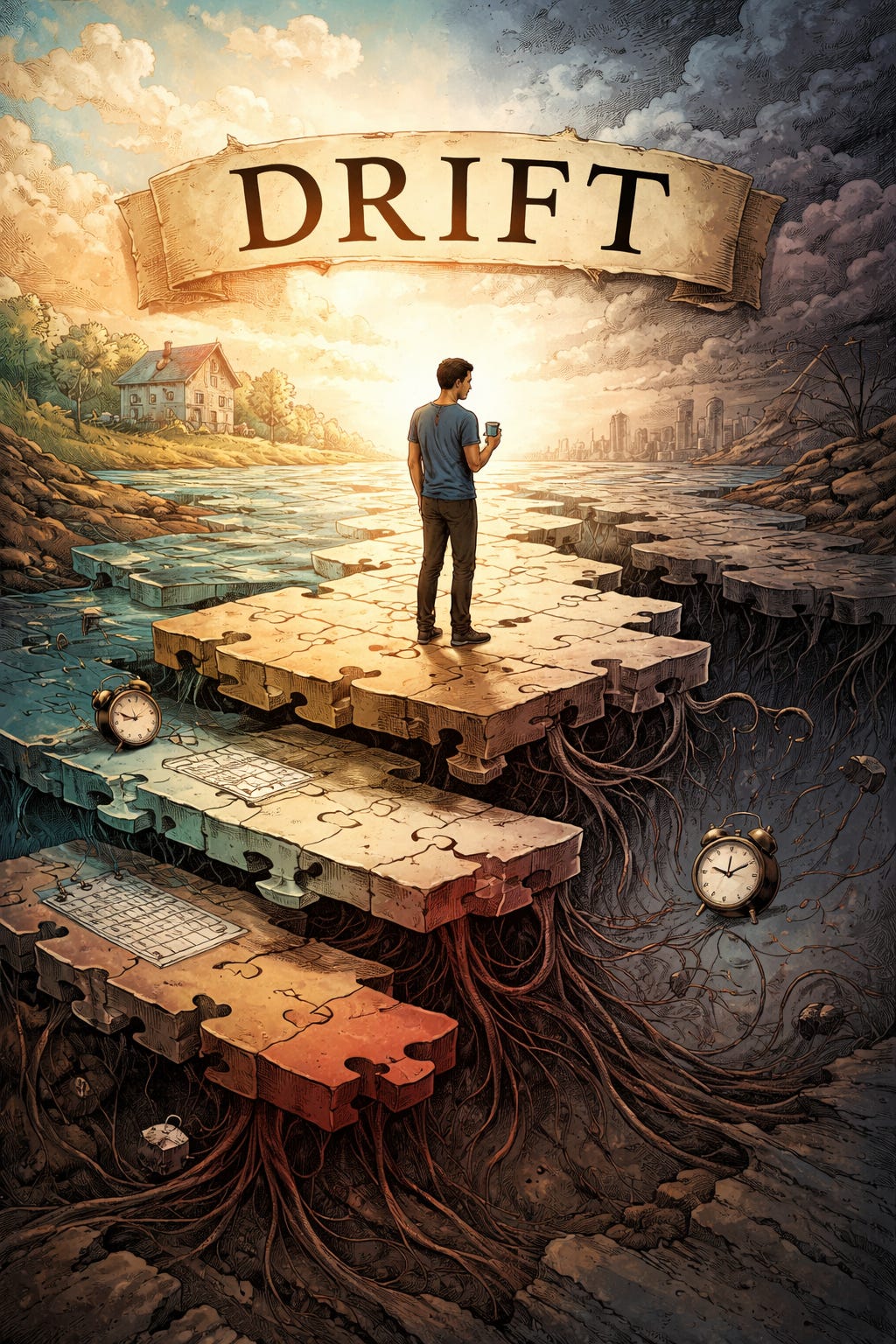
Drift is repeated tolerance of misalignment until your lived pattern has more causal power than your stated values. Drift is how most lives quietly come apart.
Not through one spectacular betrayal or a single catastrophic decision, but through small, reasonable choices that slowly move you away from the life you swear you still want. No villain monologue. No flaming wreckage. Just a long sequence of “this week is weird” eventually maturing into “how did I end up here?”
Chapter 21 begins with a rude little truth: disaster almost never kicks the door in wearing boots. It sends calendar invites for months. You keep clicking maybe.
In the language of this book, drift is what happens when:
Layer 1, your actual days, starts sliding by degrees
Layer 2, your mental map, keeps forecasting the old story
Layer 3, your emotional signal, whispers, mutters, and eventually starts throwing office supplies
You tell yourself you are “just in a busy season,” but your sleep has been bad for six months. You insist that “we’re still close,” but the friend you used to see weekly now lives entirely in your text history like a little museum exhibit called Former Intimacy. You keep calling yourself a writer, but your desk has become a premium charging station with emotional ambitions.
Nothing explodes. Patterns simply slide.
That is what makes drift so dangerous. It does not feel like collapse while it is happening. It feels like life being mildly annoying for an unusually long time.
The point of this chapter is simple: if you can learn to see those slides early, you can save yourself from the much louder scenes we later summarize as “everything fell apart.”
A Quick Refresher: Elephant, Rider, and Three Layers
If you are joining midstream, welcome to the party. Here is the short version.
The Elephant is your body and emotional system. It feels things first: jaw tension before the difficult meeting, the heaviness on Sunday night, the irritation that arrives every time a certain name appears in your inbox like a curse in Russian.
The Rider is your reflective mind. It writes the narrative, manages the calendar, explains things to yourself and others, and is extremely good at sounding reasonable while sprinting away from inconvenient data.
And your experience moves across three layers:
Layer 1: Reality. What is actually happening.
Layer 2: Map. What you believe is happening and will happen.
Layer 3: Signal. How your body feels about the gap between the first two.
Drift is basically that gap in slow motion.
The Elephant notices first. The Rider decides whether you steer or keep repeating the same story and hope physics gets more flexible.
Drift vs. Rupture
(Or, Why You Should Fear the Quiet Parts)
This chapter makes a distinction your body probably already knows: drift versus rupture.
Rupture is the blowup. The breakup, the resignation email, the kid who finally says, “I’m done talking to you,” in a tone that lets you know this was not a spontaneous decision.
Drift is the stretch before that, when everyone involved sensed something was off and mostly chose to explain it away because explaining is cheaper than changing.
In weaving language:
Drift is when the threads loosen. You still look connected, but the cloth has slack.
Rupture is when something finally tears and suddenly everyone is very interested in communication.
We tend to call therapists, mediators, and lawyers at rupture.
Chapter 21 is a plea to get curious at drift instead, when the cost of repair is still measured in honest conversations and small policy changes, not custody schedules, severance negotiations, and that very specific kind of stare people develop after saying, “I guess this has been a long time coming.”
Why You Keep Missing Your Own Drift
The chapter is blunt about why we miss drift: the Elephant and Rider are both doing their jobs, just with the elegance of a bent-legged shopping cart.
The Elephant feels the mismatch as low-grade discomfort: a little dread in the mornings, mild resentment, boredom where interest used to live, the sense that your life has developed a faint but persistent smell of burnt toast.
It wants relief now.
So it reaches for scroll, sugar, sarcasm, overwork, fantasy, shopping, micro-dissociation, or the ancient spiritual practice of opening the fridge six times as if the seventh visit will reveal purpose.
The Rider, meanwhile, hates complexity, so it picks the cheapest story available:
“This is just a busy quarter.”
“We’ll reconnect when things calm down.”
“They know I care; I don’t need to say it.”
“I’m tired, that’s all.”
“This is temporary,” said the person in year four.
Together they form a feedback loop: the Elephant suffers, the Rider rationalizes, you grab short-term soothing, and the fabric quietly loosens another notch.
The loop looks like this: Elephant discomfort rises, Rider rationalizes, short-term soothing is chosen, facts move further from forecasts, discomfort rises again. Each pass through the loop adds a little more probability weight to the life you did not mean to choose. The repair loop is different: the Rider names the discomfort as data, the Elephant gets a little regulation instead of dismissal, and together they choose one small test plus one micro-policy. That is how drift stops being fate and becomes steering.
The irony is that your nervous system is often doing you a favor. That knot in your stomach before you open your laptop is not random. It is not your body being dramatic for sport. It is data about misalignment between your story—“I’m still doing meaningful work”—and your calendar—“I have four hours of meetings about things I secretly despise.”
The whole point of Chapter 21 is to turn that vague “ugh” into an instrument panel.
And an instrument panel is only useful if you know what the lights mean. Some drift signals come from collision: one part of you wants rest while another part is still auditioning for sainthood. Some come from failure: the forecast you were living on has already been disproven by reality, but your identity has not caught up. Some come from blockage: a real need keeps slamming into a rule, a silence, or a pattern that will not let it through. When you can name the signal, the discomfort gets less mystical and more actionable.
Story: The Researcher Who Stopped Researching
One of the chapter’s smaller stories goes like this.
